
Updated official Australian emissions figures were released last week, with Western Australia recording its third consecutive year of increased emissions.
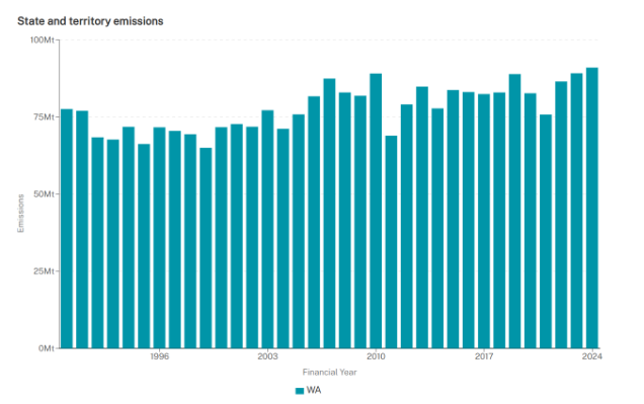
Conservation Council of WA (CCWA) Executive Director Matt Roberts said the 2024 data shows WA’s emissions have now increased nearly 20 per cent since 2005, with a 63% increase in the state’s energy sector. He said WA’s overall emissions were the highest ever recorded.
“Year on year the community is responding to real climate challenges from increasingly intense cyclones, drying in the South West and unprecedented fire seasons - there is a huge disconnect between the climate crisis and real climate action,” Mr Roberts said.
“The 2024 emissions data reveals a record high 90.94 million tonnes of greenhouse gas emissions (GHG) - an increase of more than two per cent from the previous year. This is a clear indication that the Safeguard Mechanism (SGM) is not an effective tool to deliver the emissions reduction needed.
“Despite total emissions going up, companies are getting carbon credits under the SGM because it is flawed in its design - a farce, in fact, when we need total emissions reduction, not accounting tricks to shirk responsibility
“WA is the only state without a 2030 emissions reduction target, so it is little wonder our emissions continue to rise.
“In 2024 the WA Labor government handballed emissions reduction to the Federal Government under the SGM. Unlike our state guidelines, the SGM lets emitters buy their way to emit and does not require best practice, or a GHG management plan. Nor does it apply a mitigation hierarchy.
“Despite WA deferring to the Federal SGM, it is yet to adopt Federal Government aligned reduction targets.”
Mr Roberts said CCWA was calling on the State Government to deliver a WA Climate Change Act with 1.5C-aligned emissions reduction targets.
“Twenty major WA emitters have been under review by the Environmental Protection Authority (EPA) for more than a year following the controversial decision by the State Government to stop regulating emissions reduction under the Greenhouse Gas Environmental Factor Guidelines.
“We are eager to see whether the government will choose to cut requirements for these 20 polluters and are calling on them to keep the strongest emissions reduction conditions in place.
“The government can choose to sit on his hands while our emissions continue to rise, or it can take action and play its role in addressing the climate crisis.”
BACKGROUND BRIEFING NOTES
Summary on SGM data:
- WA’s SGM emissions (47.23 Mt CO2-e) exceeded its baseline emissions number (46.17Mt CO2-e) by 2.29%.
- Emissions from 56 WA facilities exceeded their baseline.
- A combined 2,382,176 Safeguard Mechanism Credit units (SMCs) and Australian Carbon Credit Units (ACCUs) were issued to 15 WA facilities, valued at $88,283,4421
- Shell, through its FLNG facility were awarded 1,421,460 SMCs, valued at over $52 million, despite the facility’s emissions increasing by over 400,000 t CO2-e over the most recent 12-month reporting period
- WA is home to four of Australia’s seven most polluting SGM facilities, including the most polluting facility (Chevron’s Gorgon LNG plant) and the fourth-most polluting (Woodside’s North West Shelf Project).
- In total, WA’s SGM facilities accounted for 52 per cent of the state's total emissions.
- 35 WA facilities had an increase in emissions over the latest 12-month reporting period.
- 33 WA facilities have increased their emissions since the Safeguard Mechanism was reformed two years ago, despite a default decline rate of 4.9% pa over two years resulting in an emissions reduction contribution (used to calculate the emissions baseline) of 0.902 for most facilities (this effectively means facility emissions should be 10% lower than they were two years ago (at constant production)).
- For exceeding the emissions baseline for its North West Shelf facility by 921,092 t CO2-e, Woodside surrendered a combined 921,095 ACCUs and SMCs valued at $34,135,780.
- For exceeding the emissions baseline for its Gorgon facility by 478,414 t CO2-e, Chevron surrendered the equivalent in ACCUs, valued at $17,730,022.
- In WA, total safeguard facility emissions fell from 48.03 Mt CO2-e to 47.23Mt CO2-e (1.65%) thanks to external circumstances unrelated to the Safeguard Mechanism.
 |
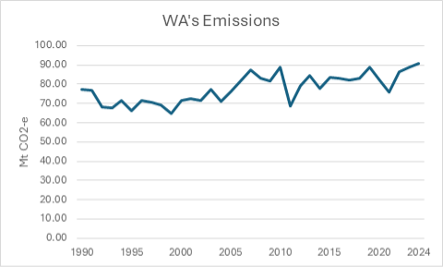 |
Figure 1&2: WA State Emissions
WA’s record totals were driven primarily by emissions from the energy sector - 81.128 million tonnes of CO2-e - a large proportion of which was produced by WA’s gas industry. The stark reality is that WA’s energy emissions have increased by 63 per cent since 2005.
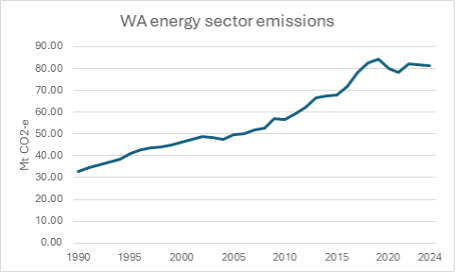
Figure 3: Emissions from WA’s energy sector.
The official figures confirm reports that WA’s emissions were on track to increase, following internal modelling by the WA government indicating the state was not on track to achieve its net-zero by 2050 target.
Increases in WA’s emissions reflect the State Government’s refusal to set a 2030 emissions reduction target; continued undermining of net-zero ambitions; and not doing its fair share to help Australia achieve its 43 per cent emissions reductions goal by 2030.
*The latest figures are for 2024, the timelapse in publishing official figures is resultant from the extensive time required for thorough data collection, analysis, and verification.
Further background on WA’s GHG Environmental Factor Guidelines
- 2019 – the EPA proposed tough new guidelines requiring LNG projects to offset 100% of their emissions. Met with intense industry backlash.
- 2019 – The EPA withdrew these guidelines within months
- 2020 – Final Guidelines released which were non-binding and not mandatory – criticised by industry for being burdensome and environment sector for being weak
- 2023 – It was revealed that the former Premier Mark McGowan had pressured the EPA chair to pull the guidelines
- 2024 – Former Environment Minister Reece Whitby effectively gutted the role of the EPA in setting conditions on emissions reduction.
- 2024 – the Minister under s46 of the EP Act referred WA top 20 GHG emitting projects back to the EPA to review the emissions reduction conditions
*Further background on the GHG policies is available on request.
ENDS
Media contact: John Cooke – 0433 679 780