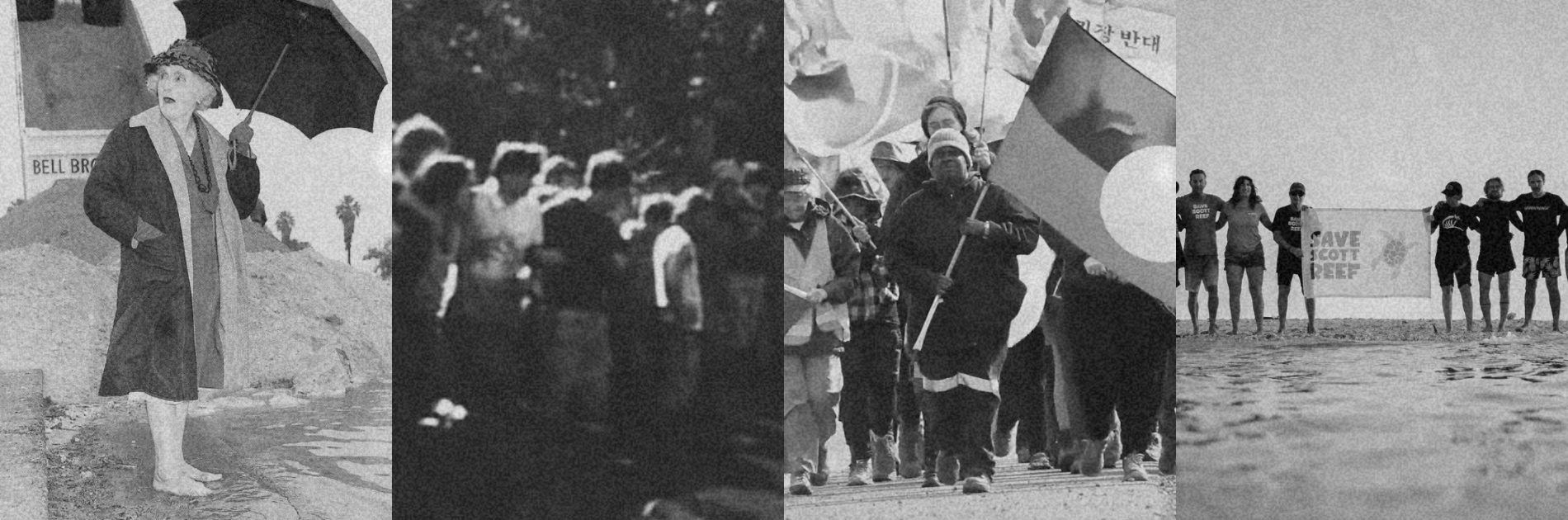
The Conservation Council of Western Australia (CCWA) started out from humble beginnings in 1967, focused on local conservation projects. By 1972, we were incorporated as the state's peak environment body. Since then, we've grown from a handful of Member Groups to over eighty, representing everything from the old growth forests of the South West to the turquoise waters of the Kimberley, and everywhere in between.
For nearly sixty years, we've supported communities to protect the people and places they love. This is our story.
1960s
Following the campaigns of the early 1960s to protect Kings Park and Mounts Bay from development, the Conservation Council of WA was established in 1967 as a coalition of the Tree Society, the Western Australian Naturalists Club, the Wildflower Society of Western Australia, and the Kings Park and Swan River Society, and focused on local conservation projects. According to the book Radical Perth, Militant Fremantle (2019):
The Kings Park and Mounts Bay campaigns were significant steps in this shift to a conservationist identity and to widespread activism. Interest in the natural environment and its protection became no longer the province of scientists and naturalists alone. Bessie’s pioneering protest against the earthmovers was repeated many times as direct action was increasingly utilised in the 1970s as a weapon, particularly in struggles to protect native forests against wood chipping and bauxite mining.
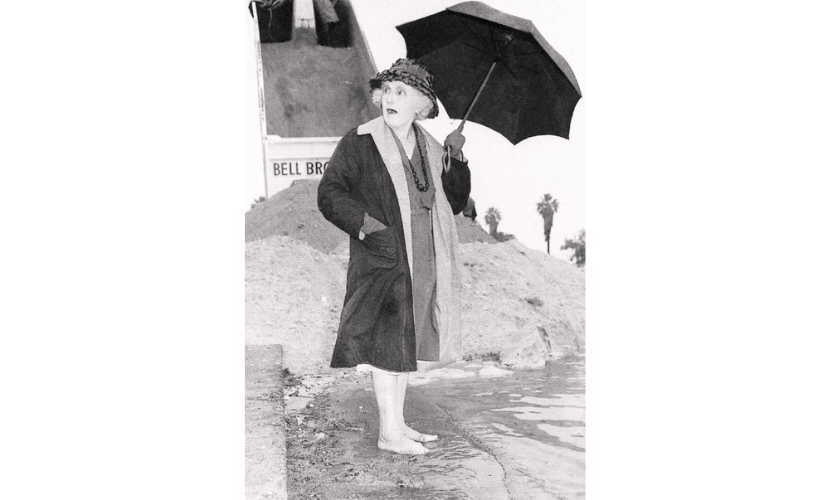
Image: Bessie Rischbieth protesting to protect Mounts Bay in 1964
The same year we were founded, we took on duck shooting as an issue. G. C. MacKinnon, the Minister for Fisheries and Fauna at the time, told the Beverley Times:
I also had to consider the arguements adduced by the Conservation Council of W.A. (which, I am told, represents 18,000 naturalists) on the effects of duck shooting on the breeding success of rare or uncommon waterbirds such as spoonbills, crested crebes and egrets which are usually still nesting at Christmas. It is not that these species are actually shot or deliberately disturbed, but the noise of gunfire and the presence of shooters frightens the parents from their nests.
1970s
We began the decade campaigning for the state government to adopt a formal nature conservation policy, which resulted in the creation of the Ministry of Conservation in 1970, and the WA Environmental Protection Authority (EPA) in 1971. We were incorporated in 1972, and by the middle of the decade, we had grown to a membership of over 20 organisations, solidifying our role as a peak body. The 1970s were focused on the expansion of industry, and opposing bauxite mining in the Northern Jarrah Forests. By 1979, we were opposing Woodside's North West Shelf proposal.
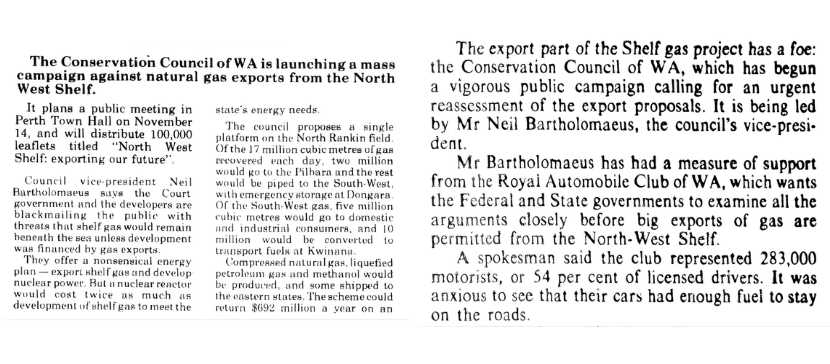 Left: Tribune, 31 Oct 1979 Right: The Canberra Times, 15 Nov 1979
1980s
In 1981, we were the plaintiffs in a class action against Alcoa in the United States, for its bauxite mining in the Northern Jarrah Forests. In 1985, together with the Australian Conservation Foundation (ACF), we filed legal objections to the leases taken out by Worsley Alumina. We also helped ensure the gazettal of the Shannon National Park in 1988. Throughout the decade, we campaigned around pollution control, energy policy, land clearing, and habitat destruction.
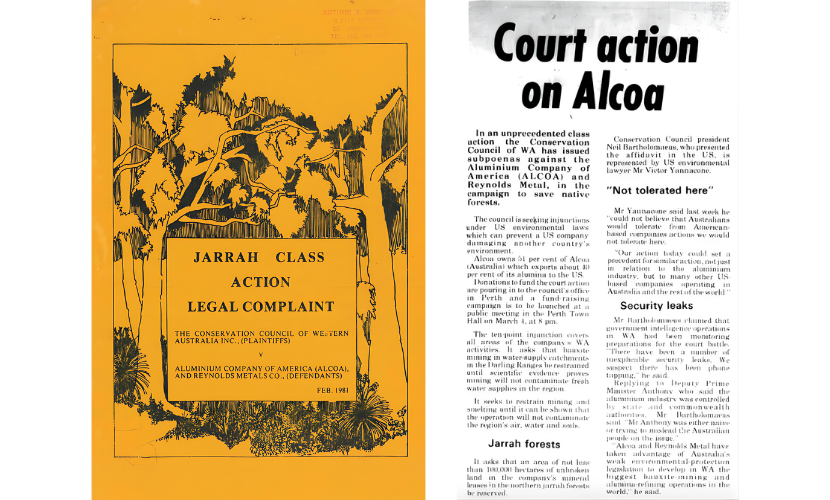
Left: Court document Right: Tribune, 4 Mar 1981
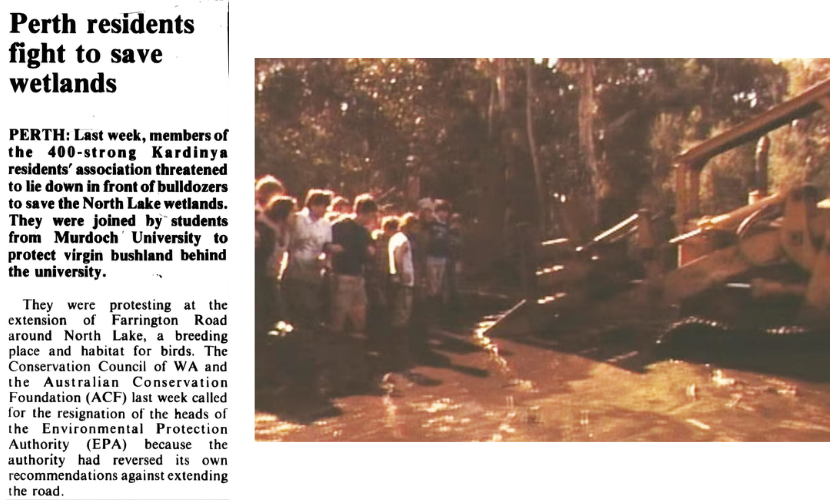
Left: Tribune, 19 Sep 1984 Right: Farrington Road protesters (Credit ABC News)
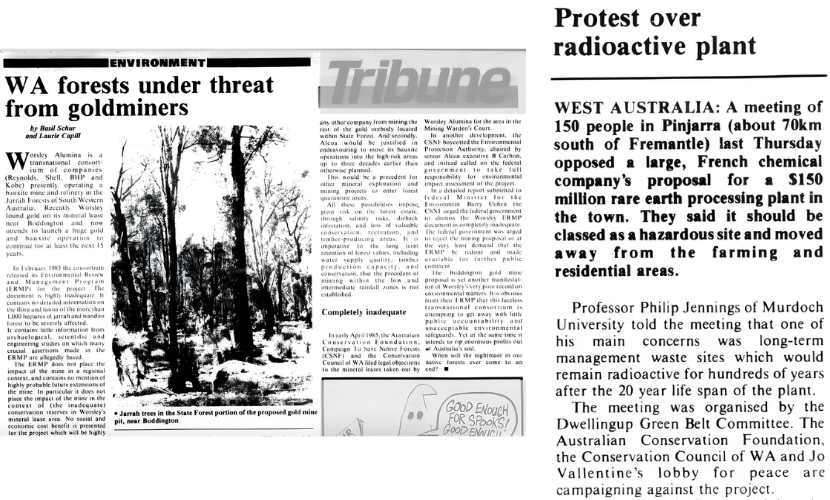
Left: Tribune, 22 May 1985 Right: Tribune, 4 May 1988
1990s
We helped ban recreational duck shooting in 1990, put Shark Bay World Heritage Area on the World Heritage List in 1991, and ensured the gazettal of the Lesueur National Park in 1992. We campaigned to protect old growth forests in the South West, where we supported direct action, such as the Giblett Forest Rescue. In 1994, we launched our most prestigious award, the Bessie Rischbieth Conservation Award, in honour of feminist and activist Bessie Rischbieth (1874-1967). Together with a group of lawyers, we formed the Environmental Defender's Office (EDO) in WA in the middle of the decade.
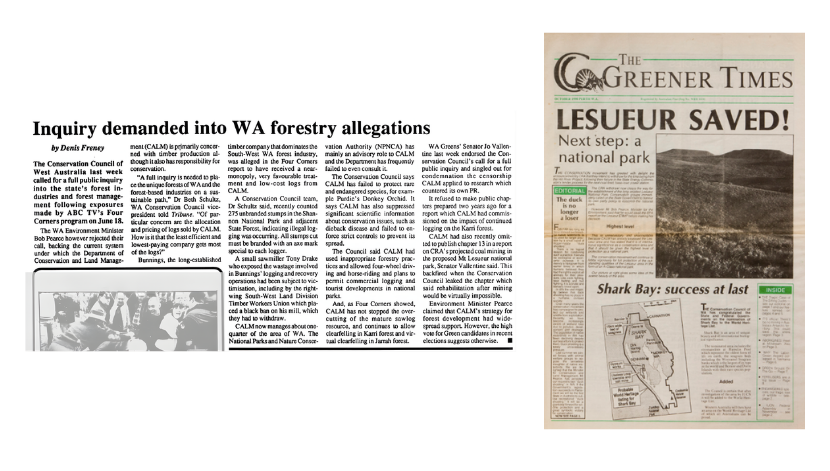
Left: Tribune, 27 Jun 1990 Right: The Greener Times by CCWA, Oct 1990
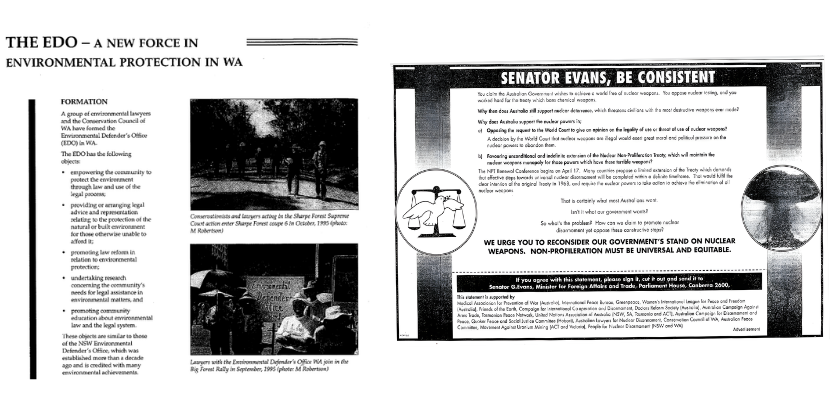
Left: EDO formation announcement in 1995 Right: Open letter in The Canberra Times, 29 Mar 1995
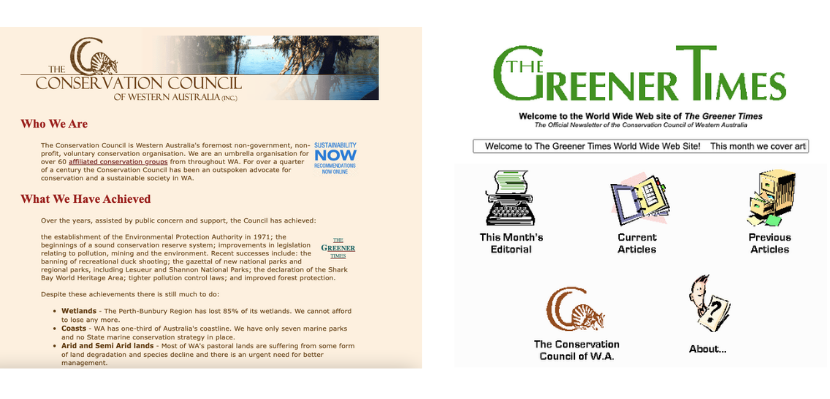
Left: Our main website in the late 1990s Right: Our Greener Times news website in the late 1990s
The 'About' section of our Greener Times website read:
Along with most of the rest of the world, Western Australia has many critical environmental issues facing it and The Greener Times, with its many contributors throughout the wider community, has become an important forum for debate about environmental issues in a time when both the Government and mass media in general have lost interest in the environment.
This is the magazine's first attempt at presenting information on the World Wide Web but, finances permitting, this web site may grow into more than purely a reference source for current and previous articles and provide a more complete mechanism for facilitating greater national and international awareness of the unique environmental issues facing WA and stimulate international co-operation and discussion on these matters.
2000s
In 2001, we helped secure the Regional Forest Agreement, which aimed to protect karri and jarrah forests. We also spent the first half of the decade co-leading the Save Ningaloo Reef campaign, which pressured the state government to reject a proposed marina and expand the Ningaloo Marine Park's protections. In 2008, the Nuclear Free campaign joined CCWA, working with Traditional Owners to oppose uranium mining on their Country. In the late 2000s, we opposed mining in Bungalbin/Helena and Aurora Range, which triggered a government review of its conservation status.
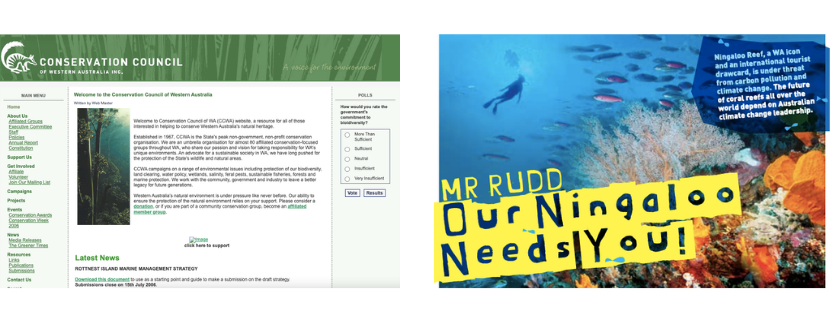
Left: Our website in the 2000s Right: Postcard petition to the Prime Minister in 2009
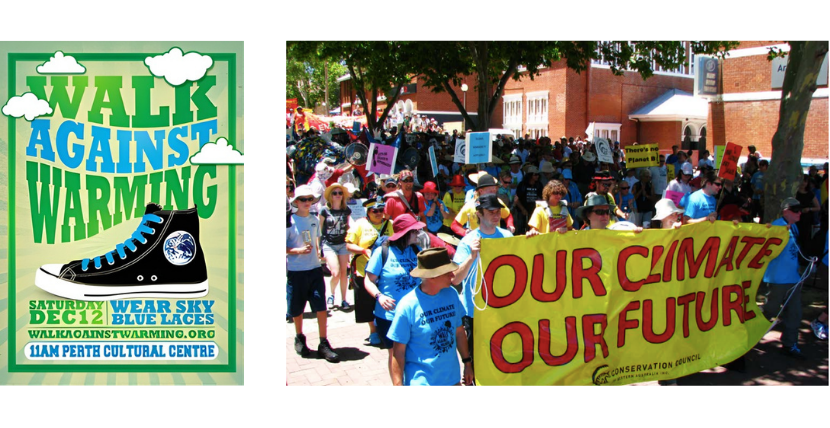
Left: Walk Against Warming poster Right: Walk Against Warming in Northbridge 2009
2010s
This decade saw us strengthen our opposition to fossil fuel expansion, as well as biodiversity threats from mining and land clearing. In 2013, we supported Traditional Owners and Kimberley locals to successfully protect Walmadan/James Price Point from Woodside's gas proposal. We also expanded our Citizen Science program. In the late 2010s, we were part of the coalition of groups that helped save Beeliar Wetlands from the proposed Roe 8 highway, helped secure a ban on fracking in WA's South West, launched our Clean State climate action and clean jobs campaign, and supported the Protect Ningaloo campaign. As part of our Nuclear Free work, we supported Traditional Owners in taking uranium miner Cameco to the Supreme Court in 2019. Finally, after sustained advocacy throughout the 2010s, the state government enacted their Container Deposit Scheme in 2020.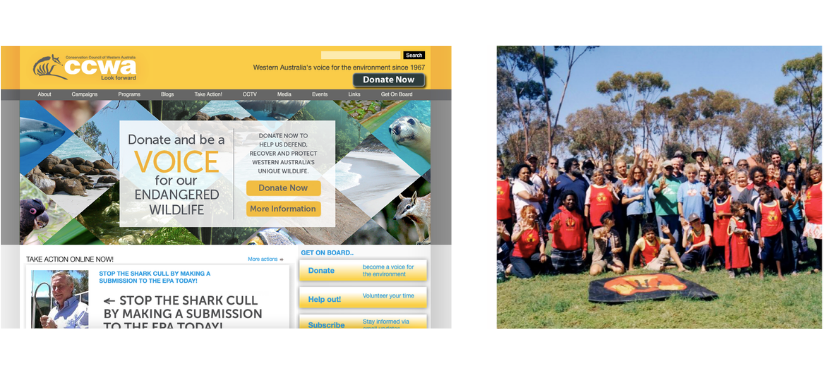
Left: Our website in the 2010s Right: WA Nuclear Free Alliance first meeting, Mar 2010 (Credit Jessie Boylan)
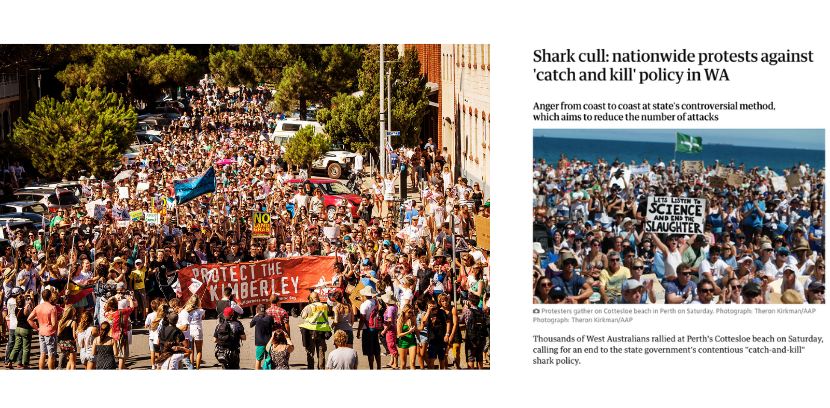
Left: James Price Point Protest, Fremantle (Credit Adam Monk) Right: The Guardian article, 1 Feb 2014
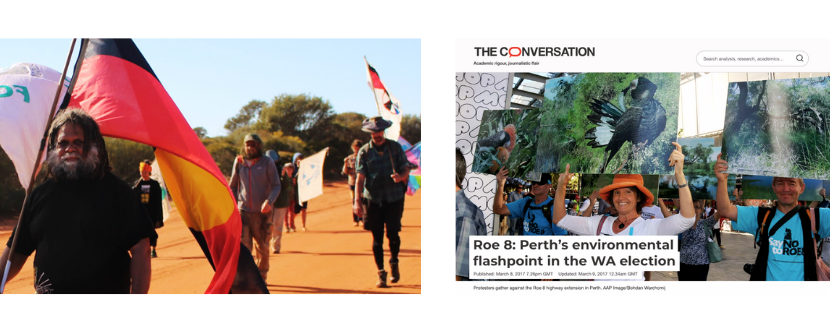
Left: Walkatjurra Walkabout 2015 Right: The Conversation article, 2017
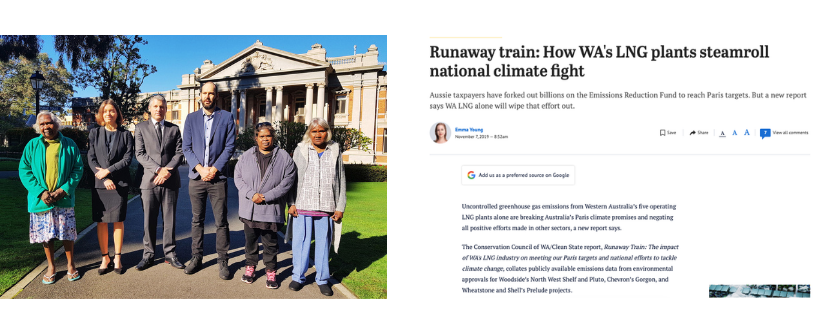
Left: Yeelirrie Supreme Court Case 2019 Right: WA Today article, 7 Nov 2019
2020s
In 2021, after 40 years of supporting community campaigning led by the WA Forest Alliance and others, we celebrated the end of native forest logging in WA's South West. The following year, we took Woodside to the Supreme Court to challenge their Burrup Hub gas projects. In 2023, we established Go Beyond Gas, our campaign to end new gas developments, as well as our Indigenous Advisory Board to help ensure that Indigenous voices, culture, and knowledge are central to our conservation efforts. We launched the Defend WA's Nature alliance in 2024, which advocated for strong federal nature laws.
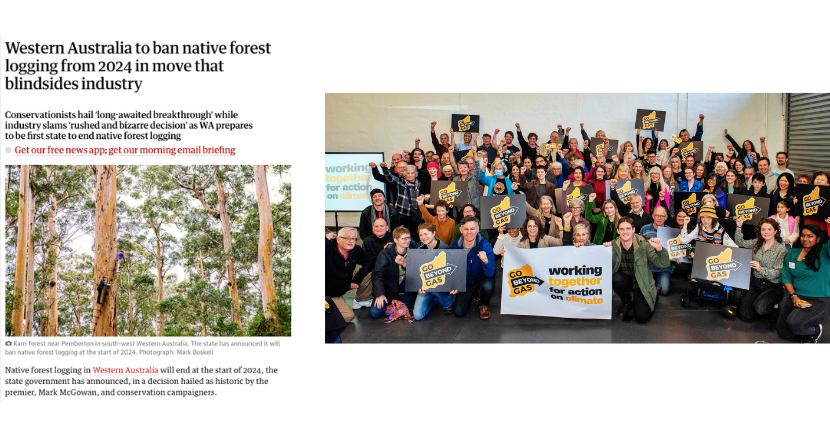
Left: The Guardian article, 8 Sep 2021 Right: Go Beyond Gas Launch 2023
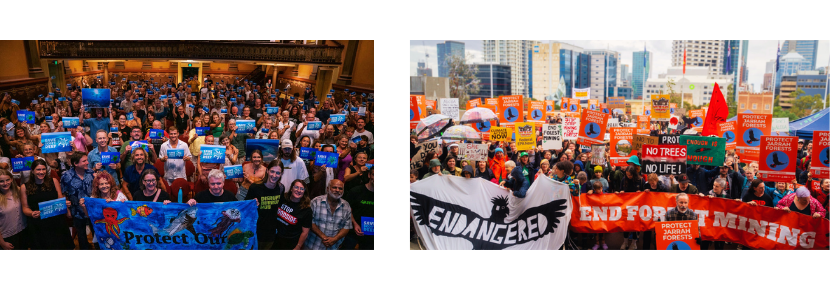
Left: Save Scott Reef Launch 2024 Right: Big Jarrah Walk 2025