By Dr. Stefan Eberhand, Former Honorary Associate, Western Australian Museum; Co-founder at Save the Nullarbor Inc.
Project: Western Green Energy Hub (WGEH)
Location: Nullarbor Plain
Impact: Impact to caves and karst region of World Heritage significance.
The Nullarbor Plain is the world’s largest arid limestone karst,* which is recognised nationally and internationally for its World Heritage values. The Nullarbor meets all four of UNESCO’s natural heritage criteria for World Heritage, based on its caves, karst landforms, and associated features such as cave minerals, speleothems, palaeo-environmental records, sub-fossil bones, and rare or endemic subterranean species and ecosystems (Davey et al, 1992). Outstanding natural attributes of the entire Nullarbor also include the world’s greatest area of cave-systems in an arid environment; a record of ancient forms of life preserved in the caves; the world’s longest escarpment, including lengthy lines of spectacular sea cliffs; and the remarkable surface environment of the astoundingly flat Nullarbor Plain itself (Eberhard & Law, 2025).
Despite a compelling and growing body of scientific evidence compiled over the last 35 years, World Heritage nomination has not been progressed in Western Australia. This contrasts with South Australia (SA), which has already granted around one-third of the Nullarbor karst a high level of protection (Fig 2) and the SA Government is supporting World Heritage nomination for the SA portion of the Nullarbor and Great Australian Bight. A cogent case for protection also applies to the two-thirds portion of the Nullarbor karst located in Western Australia, which harbours the majority of outstanding individual karst features including Cocklebiddy Cave, Weebubbie Cave, and Abrakurrie Cave for example . A comprehensive reappraisal of the entire Nullarbor limestone region, embracing assessment of natural, cultural and marine ecosystem values, is long overdue.
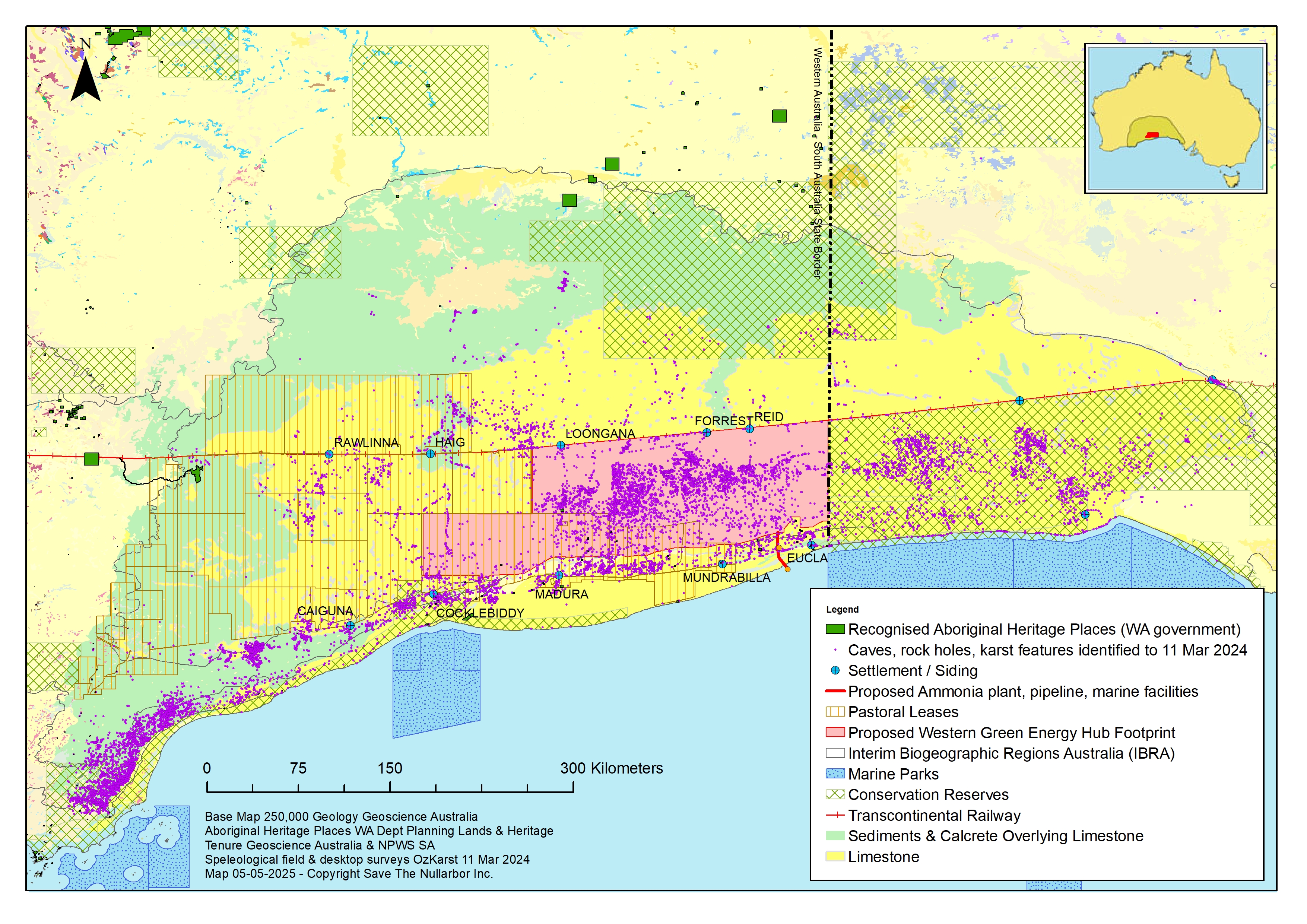
The Western Green Energy Hub (WGEH) is a proposed 70 GW pa renewables-powered hydrogen and ammonia production and export venture. The project proposes 3,000 wind turbines and 60 million solar panels on 22,000 square kilometres of the Nullarbor (Fig 1), a new marine port and town for ~8,000 people, desalination plant, ammonia plant and storage tanks, construction workshops, ~35 hydrolyser plants, quarry, and thousands of kilometres of roads, powerlines and pipelines.
The proposed envelope of the WGEH sits atop the central portion of the Nullarbor karst, a region containing the highest density of recorded karst features, including multiple highly significant caves with rare and endemic cave species, speleothems, subfossil bones, and cultural heritage values (Fig 1). The development envelope contains more than 4,500 karst features, including over 400 caves, over 500 rock holes, over 1,900 blowholes, and over 1,470 dolines (Fig 2).

If the WGEH proceeds, the development will impact a vast swathe of fragile karst landscape, soils, vegetation, caves, Aboriginal cultural heritage, underground ecosystems and connected marine ecosystems. Even if infrastructure could be located to avoid the thousands of known karst features, there would be cumulative damage done to landscape, soils, vegetation, caves, dolines, blowholes, rock holes and cultural sites over ensuing decades due to the indirect impacts of a huge increase in vehicles and visitation by several thousand more people living in the area. These indirect impacts would not be confined to the project envelope, and would extend across the Nullarbor region, especially into neighbouring conservation reserves, namely Eucla National Park, Nuytsland Nature Reserve, Nullarbor National Park and Wilderness Protection Area.
As a signatory to the UNESCO World Heritage Convention, Australia has an obligation to identify and protect areas of Outstanding Universal Value (Articles 3 and 4 of the Convention). Allowing any damage to the Nullarbor’s outstanding natural and cultural values would be a breach of Australia’s legal responsibilities and obligations under the Convention . The Australian Government may have a legal obligation under international law to use its powers to initiate a process for World Heritage nomination of the Nullarbor. This includes the power under Section 14 of the Environment Protection and Biodiversity Conservation Act, 1999.
State governments also have an important role to play in facilitating a cooperative national approach such as through the Intergovernmental Agreement on the Environment .
Recommendations
- Bioregional planning to identify where environmental and cultural, and in this case – world heritage - values are not compatible with development, thus informing the identification of no-go zones and planning for protected areas.
- Proactive project filtering that rules out proposals in areas with outstanding natural and cultural heritage values.
A holistic management approach to the Nullarbor karst region and its heritage values, with funding and resources to provide the highest level of protection, as prescribed by the IUCN Guidelines for Cave & Karst Protection (Gillieson et al., 2022)
(See Recommendation 2 under ' Adopt a Bioregional Planning Framework ' and Recommendation 14 under ' Proactive Project Filtering ')
Citations
Eberhard, S., M & Law, G., (2025). ‘The World Heritage attributes of the Nullarbor Plain Australia’, Bob Brown Foundation Inc. and Save the Nullarbor Inc., Tasmania, 96pp
Davey, A. G., et al. (1992). ’World Heritage significance of karst and other landforms in the Nullarbor region - a report to the Commonwealth Department of the Arts, Sport, the Environment and Territories.’ Commonwealth of Australia, Canberra.
Gillieson, D., et al. (2022). ’Guidelines for Cave and Karst Protection.’ 2nd edition. Postojna, Slovenia: International Union of Speleology & IUCN.
* Karst landscapes are formed by the dissolutional weathering of soluble carbonate rocks such as limestone, often characterised by well-developed subterranean drainage systems and karst features including caves, dolines, blow holes, and springs.